Beautiful, long-lasting eyelash extensions don’t come from the adhesive alone. They come from the right glue paired with correct application technique, proper isolation, and ongoing professional education. Get any one of these wrong, and even the best lash adhesive on the market won’t save the result.
That said, eyelash glue is still the foundation everything else is built on. It affects retention, application speed, client comfort, and safety. This guide walks you through the different types of lash glue, how to choose the right one, and the mistakes that quietly ruin good results.
What Is Eyelash Glue?
Eyelash glue — also called lash adhesive — is the bonding agent used to attach lashes to the eyes. But “lash glue” isn’t one product; it covers three very different formulas:
Professional eyelash extension adhesive – creates a semi-permanent bond between an extension and a single natural lash.
Strip lash glue – designed for temporary false lashes that come off at the end of the day.
Self-adhesive lashes – strip lashes with adhesive built into the band, made for quick, occasional use.
These aren’t interchangeable. Each is formulated with a different curing speed, flexibility, and holding strength for its specific job.
Types of Eyelash Glue
1. Professional Eyelash Extension Glue Built for certified lash artists performing semi-permanent extensions. It cures fast and bonds strongly — which is exactly why it demands proper training, precise isolation, and controlled application. A fast-curing adhesive in untrained hands causes more problems than it solves.
2. Strip Lash Glue Slower-drying and more forgiving than extension adhesive, making it easier for beginners to work with. Great for everyday makeup, weddings, or occasional wear — but it should never be used for extensions, since it isn’t designed to bond with individual natural lashes long-term.
3. Self-Adhesive Lashes No separate glue needed — the adhesive is built into the band. Convenient for travel or short-term wear, but they don’t match the durability, comfort, or natural finish of professionally applied extensions.
Feature
Professional Extension Glue
Strip Lash Glue
Purpose
Semi-permanent extensions
Temporary false lashes
Applied by
Certified lash artist
Anyone
Retention
4–6 weeks (with aftercare)
One day
Drying speed
Fast
Moderate
Skill level needed
Professional
Beginner-friendly
Removal
Professional removal recommended
Removed easily at home
How to Choose the Right Eyelash Glue
The “best” adhesive isn’t the strongest or the most expensive one — it’s the one that matches your skill level, environment, and the service you’re providing.
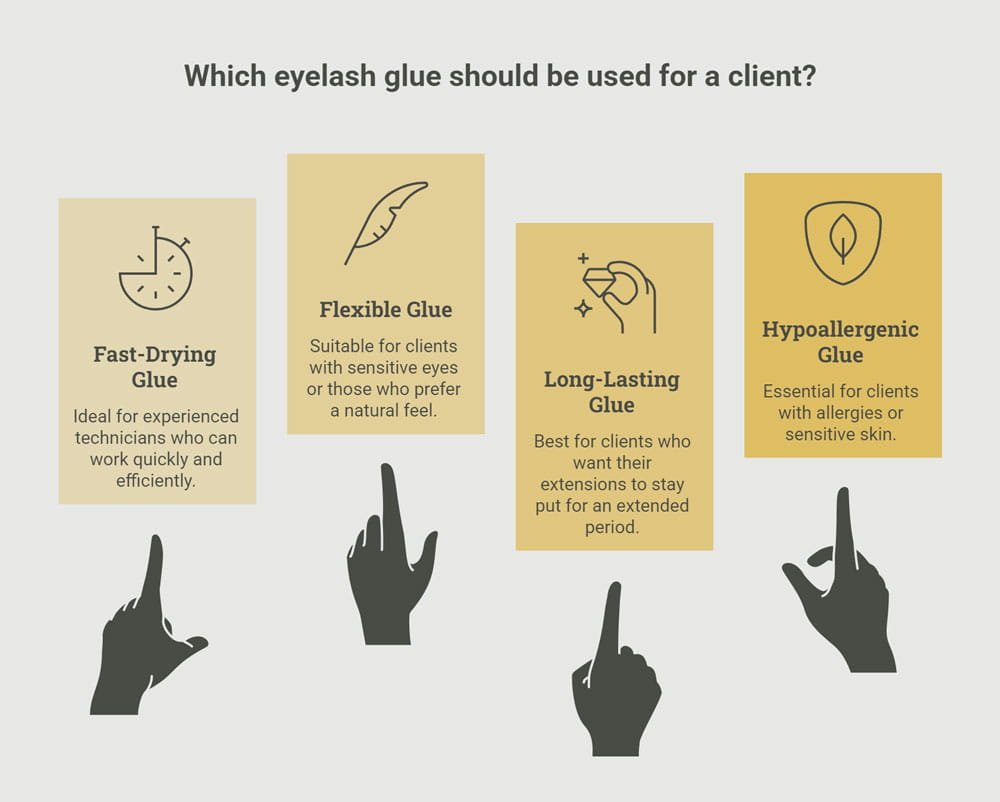
1. Drying time — Faster-drying adhesives suit experienced artists who need speed. Beginners generally do better with a slower cure that allows more time for accurate placement.
0.5–1 second: advanced artists
1–2 seconds: intermediate professionals
2–3 seconds: beginners and students
2. Humidity and temperature — Adhesive curing speed changes with the room environment, and this matters a lot for salons working in variable Indian conditions. (We’ve covered this in depth — including season-by-season adjustments — in our Eyelash Extension Glue Guide for Indian Climates.)
3. Client sensitivity — For sensitive eyes, a low-fume adhesive combined with a proper consultation beforehand makes a real difference in comfort.
4. Retention requirements — A bridal client who needs 3 days of flawless lashes has different needs than a regular who wants 5–6 weeks of low-maintenance wear. Match the adhesive to the goal, not the other way around.
5. Your experience level — The right glue for a beginner isn’t always right for a five-year veteran. Moderate-curing adhesives give beginners more control; faster ones become manageable with practice.
Black vs Clear Lash Glue
Black glue blends into the lash line and eyeliner, making extensions look fuller — the standard choice for classic, hybrid, and volume sets.
Clear glue dries transparent, which works well for lighter lashes, coloured extensions, or a softer, more natural finish. It’s also commonly used for strip lashes.
Neither is objectively better — it depends on the client’s natural lash colour and the look you’re going for.
Mistakes That Quietly Ruin Retention
Using too much adhesive — more glue doesn’t mean a stronger bond; it usually means clumping and slower curing.
Choosing glue by price alone — the cheapest option often costs more in redos and unhappy clients.
Ignoring the room’s humidity and temperature — the same adhesive can perform very differently across seasons.
Using expired adhesive — lash glue has a shelf life; expired product cures poorly and holds worse.
Skipping proper training — this is the single biggest factor in retention problems, and no adhesive upgrade fixes it. More on this below.
How to Store Eyelash Glue Properly
Store in a cool, dry place, away from direct sunlight.
Close the bottle immediately after every use.
Shake thoroughly before each appointment.
Avoid excess humidity and heat near your storage area.
Replace adhesive according to the manufacturer’s shelf-life recommendation.
Why Training Matters as Much as the Adhesive
Here’s the one thing worth repeating: the adhesive is only half the equation. Retention, comfort, and safety come from isolation technique, lash mapping, and adhesive control — skills that are learned, not shipped in a bottle. A premium adhesive in untrained hands still produces stickies, poor retention, and uncomfortable clients.
At NovaLash India, our training programmes cover adhesive science, isolation, lash mapping, and hygiene standards alongside product knowledge — because we’ve seen firsthand that technique, not the bottle, is what separates a lash set that lasts six weeks from one that falls out in six days.
FAQ
What’s the best eyelash glue for professional extensions? It depends on your drying-speed preference, room environment, and experience level. Look for a professional-grade adhesive with reliable curing time and proven retention performance rather than the “strongest” claim on the label.
How long does eyelash extension glue last on the lashes? Typically 4–6 weeks with proper aftercare, though this varies with the client’s natural lash cycle. Most clients need a refill every 2–3 weeks.
What’s the difference between extension glue and strip lash glue? Extension glue creates a semi-permanent bond with a single natural lash. Strip lash glue is made for temporary wear and removal at the end of the day. They’re not interchangeable.
Is professional lash glue safe for sensitive eyes? Yes, when a low-fume adhesive is used and applied correctly following a proper consultation. Technique matters as much as the product here.
How should eyelash glue be stored? Cool, dry, away from sunlight and humidity, sealed tightly after every use, and replaced by its shelf-life date.
Can beginners use professional-grade adhesive? They can, but fast-curing professional adhesives leave little room for error. Most beginners get better results — and fewer mistakes — starting with a moderate curing speed while building technique.
Does more expensive glue mean better retention? Not necessarily. Premium adhesives tend to perform more consistently, but retention ultimately comes down to application technique, environmental conditions, and aftercare.
Does humidity really affect how lash glue performs? Yes, significantly — high humidity speeds up curing, low humidity slows it down. For a full breakdown of adjusting adhesive choice across India’s different climates, see our dedicated climate guide.